
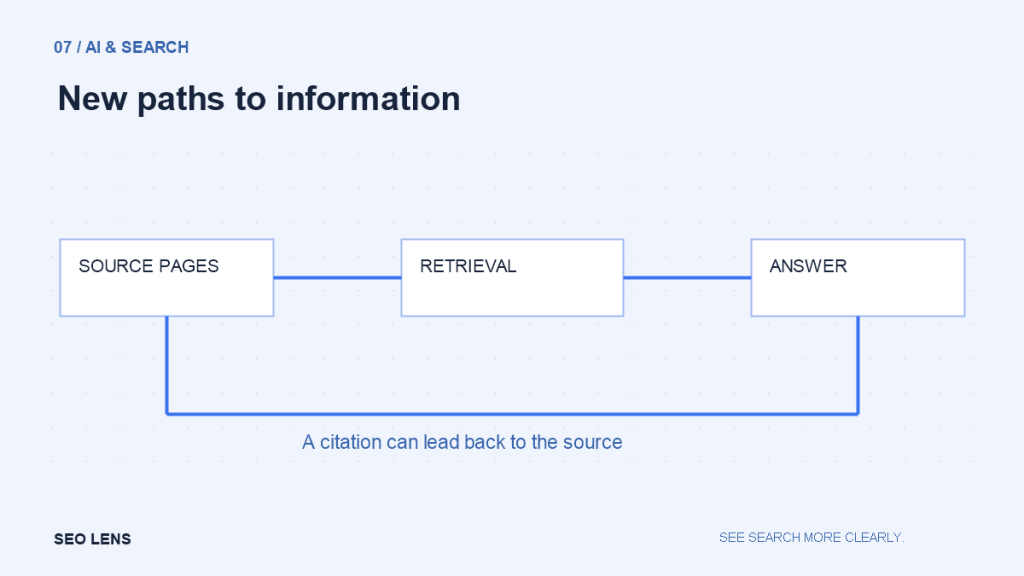
AI-generated answers add another interface between a question and a publisher’s page. A system may retrieve documents, combine information and show a response with selected citations. The user may follow a source, refine the question or leave without visiting a website.
That changes the discovery path, but it does not create a single universal “AI ranking algorithm.” Products differ in their retrieval systems, interfaces, source controls and reporting. A useful strategy begins by identifying the product and behavior you are observing rather than treating all generated answers as the same channel.
Separate training from retrieval A model’s training process and a product’s live retrieval process are different concepts. A page appearing in a citation does not establish that it was used to train the model. A crawler visit does not, by itself, reveal how the content will be used later.
Read each provider’s current documentation for crawler controls and search participation. Names, behaviors and policies can change. Avoid applying one provider’s rules to another merely because both products produce conversational answers.
For a site owner, the practical questions are narrower: can the relevant service access the intended public content, does the page contain a useful answer, and can people follow a citation to a clear source? These can be investigated without making claims about hidden model internals.
Retrieval changes the unit of discovery A conventional results page presents multiple destinations. An answer system may assemble material from several pages into one response. In that setting, a specific explanation, table or finding can matter even when the whole article is not the final reading destination.
Make important statements understandable in context. Define the subject, explain the measurement and state limitations near the claim. A number separated from its date, method or population is easy for both humans and automated systems to misinterpret.
This is a reason to write clearly, not to split every sentence into a formulaic answer block. Long arguments still need connected reasoning. Use headings to organize ideas and concise summaries where they help a reader locate the relevant section.
Citations are evidence of one response If an answer cites your page, record the query, product, date and visible response. That is a useful observation. It does not prove that your site will be cited consistently, that all users see the same answer or that the mention generated a visit.
Repeated observations can help identify patterns, but they are still samples. Be explicit about the prompts and markets tested. A monitoring tool’s visibility score describes its methodology and sample, not the entire population of AI interactions.
Inspect citation quality as well as presence. Does the cited source actually support the claim? Does the link lead to the right page? A mention that misrepresents your work may call for clearer wording or a correction request, not celebration of a visibility count.
Entity clarity helps readers first Use consistent names for the publication, products and concepts you discuss. Explain who produced a study, which version of a tool was tested and when an observation was made. Provide an identifiable source for claims that depend on external evidence.
Do not invent credentials or manufacture an elaborate organization profile to appear authoritative. A small publication can describe its actual scope and editorial approach honestly. Consistency is useful; fictional expertise undermines trust.
When a subject has ambiguous names, define the meaning you intend. A short clarification can prevent confusion for a reader and may make the page easier to interpret in automated retrieval. That is a reasonable design goal, not a guarantee of citation.
Traditional SEO still supplies the foundation Public accessibility, clear links, useful content and sensible page structure remain practical concerns. An inaccessible article cannot serve a human who follows a citation. A broken destination wastes whatever visibility the answer interface provided.
Google’s documentation for its AI search features states that existing SEO fundamentals remain relevant and does not prescribe a special AI markup requirement. Treat that as a statement about Google’s features, not a universal rule for every provider.
Use the crawl and index guide to diagnose ordinary access issues. Keep structured data aligned with visible content, and do not add unsupported claims merely to make a machine-readable profile look richer.
Measure several outcomes separately Track observed citations, identifiable referral visits and useful activity on the destination as distinct measures. They describe different stages. A response can mention a brand without linking it; a link can appear without being clicked; a visit can occur without a useful outcome.
Expect attribution gaps. Apps, browsers and privacy settings can affect referral information. Do not label all unexplained direct traffic as AI traffic. If a measurement cannot distinguish the source, preserve that uncertainty in the report.
For an experiment, choose a limited group of existing pages. Improve clarity, sourcing and structure, record the changes, then observe a defined query sample and site outcomes over time. Avoid claiming a special optimization technique from a handful of screenshots.
Choose durable editorial investments Original examples, maintained references and transparent methods give readers reasons to trust and revisit a page. Those are worthwhile even if a particular answer interface changes. A strategy built around one temporary prompt trick has a much shorter shelf life.
Keep a review schedule for fast-changing subjects. Date observations, link to primary documentation and correct material when the evidence changes. Resist forecasts that search traffic will either disappear entirely or remain unaffected; both can outrun the available evidence.
The immediate task is to understand new discovery paths while keeping the destination useful. Our measurement framework helps distinguish visible activity from a defensible business conclusion.