
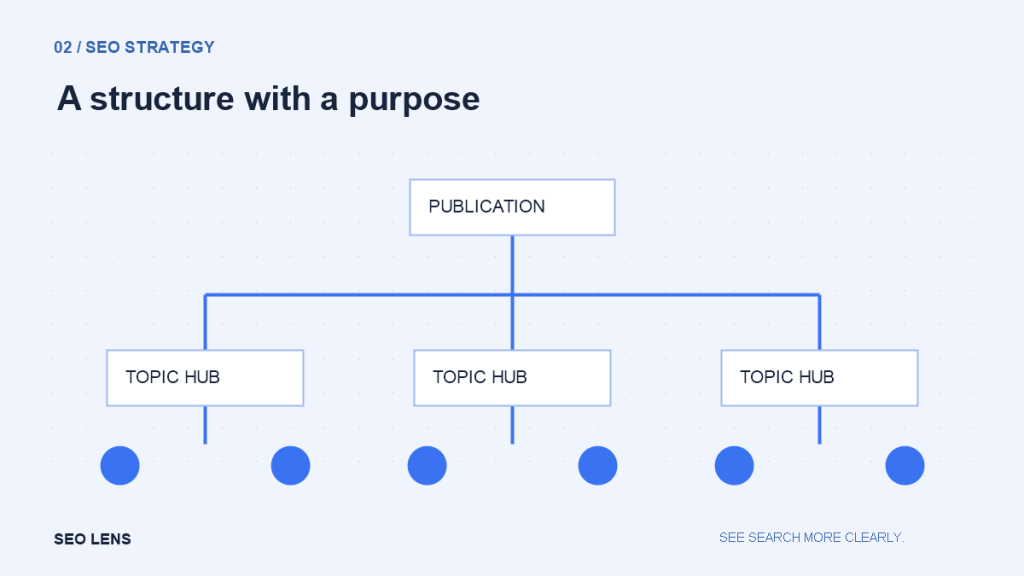
Site architecture is the set of paths that helps a reader move from a broad need to a useful answer. Menus matter, but so do category pages, contextual links, breadcrumbs and the destinations your templates expose. A tidy URL hierarchy cannot compensate for a site where important pages are difficult to reach.
Start with the user’s task. A small business owner investigating technical SEO might need a plain explanation, a diagnosis checklist and then a guide to a specific problem. Those pages form a useful journey even if they are not arranged in a perfect tree. Architecture should support that journey while keeping the site’s main subjects recognizable.
Inventory before rearrangement Export published URLs with titles, content types and available performance data. Add the current parent, category and internal link count when you can. Keep the original export so that later changes can be traced. A redesign planned only from the menu will miss pages that are already disconnected.
Classify each page by the job it performs: overview, detailed explanation, comparison, tool, reference or conversion destination. Two pages using different keywords may still do the same job. Conversely, two pages about the same subject may be useful because they answer different questions at different stages.
Mark pages for retention, improvement, consolidation or separate review. Do not delete everything with little traffic. New pages, support references and niche answers may be valuable despite limited search demand. For consolidation, choose a destination that preserves the useful material and plan redirects before changing addresses.
Build hubs that earn their place A hub should explain the topic, establish a useful sequence and guide readers to more specific resources. A title followed by a wall of links is sometimes enough for a simple directory, but it is rarely the best learning resource. Add orientation where it reduces uncertainty.
For example, a technical SEO hub might distinguish access problems from indexing problems, then link to the relevant checks. That structure lets a reader choose the next step. It also gives editors a clear place to connect future articles, so each new publication does not depend on the homepage for visibility.
Keep hubs focused. If a category has only one weak article and no distinct purpose, a separate landing page can create unnecessary maintenance. Six topics on an eight-article publication are a starting taxonomy, not evidence of six comprehensive resource centers. Describe what is present accurately and deepen the sections over time.
Think in paths, not a magic click-depth number Click depth measures how many links separate a starting point from a destination. It can highlight buried pages, but there is no universal depth that makes every site good. A specialized archive may reasonably need more steps than a primary service or an essential guide.
Compare depth with importance. A revenue-critical product hidden behind several weak categories deserves attention. A historical announcement several levels down may not. Large sites also have multiple entry points, so a homepage-only crawl is only one view of the system.
Use contextual links to shorten meaningful journeys. A discussion of indexing should lead naturally to a guide about discovery and crawling. This helps readers at the moment the need arises. Adding the same link to every footer simply to reduce a reported depth can be a less useful intervention.
Detect orphan pages with more than one source A crawler sees what it can reach. It cannot reliably tell you about all the pages it never encountered. Compare its output with a CMS export, XML sitemap and available analytics or search data. URLs found outside the crawl are candidates for review, not an automatic list of errors.
Investigate why each group is disconnected. A campaign landing page may intentionally sit outside ordinary navigation. A neglected evergreen article may need a hub link. A removed product could require an alternative destination or a genuine unavailable response. The cause determines the action.
Keep an exception list with an owner and explanation. Otherwise the same intentional pages will reappear in every audit and consume attention that should go to new problems.
Separate navigation labels from query research Navigation should be understandable at a glance. Short labels such as “Analytics” usually work better than long strings of search phrases. Put detailed language into the destination page where it can explain scope and help users choose.
Avoid building a separate category for every keyword variant. The result often divides related material into thin, overlapping archives. Use query research to understand needs, then choose a taxonomy that an editor can maintain and a reader can predict.
Breadcrumbs can explain location without replacing other links. On a publication, an article can have one primary topic for a stable breadcrumb while still linking to related work elsewhere. Choose a consistent rule instead of letting every available tag appear as an equally important parent.
Test a proposed structure before migration Take five common visitor tasks and trace the routes through the proposed site. Can a newcomer identify a starting point? Does each destination suggest a useful next step? Is the same label used consistently? Test on a narrow screen, where an expansive desktop menu may become difficult to scan.
Create a redirect map for addresses that must change. Update internal links to the destination rather than relying indefinitely on redirects. Review canonicals and sitemaps after launch. A visual redesign and a URL migration are different changes; separating their checks makes failures easier to locate.
Maintain the structure as content grows Add an architectural check to publication: choose a relevant hub, add at least one justified incoming link, and decide where the reader should go next. The point is not a minimum link quota. It is to avoid publishing isolated pages without a role.
Review sections when their purpose changes. A category may outgrow a flat list and need a better overview, while another may need consolidation. Evaluate browsing success and search visibility together. More indexed archives or more internal links are not useful goals by themselves.
Our internal linking guide develops the page-level choices that make this structure work. For Google’s description of discoverable link markup, see its link best practices.