
Calling a query “informational” is often correct and still not enough to brief a useful page. A person searching for a definition, a troubleshooting procedure and a research comparison may all want information. They need very different answers.
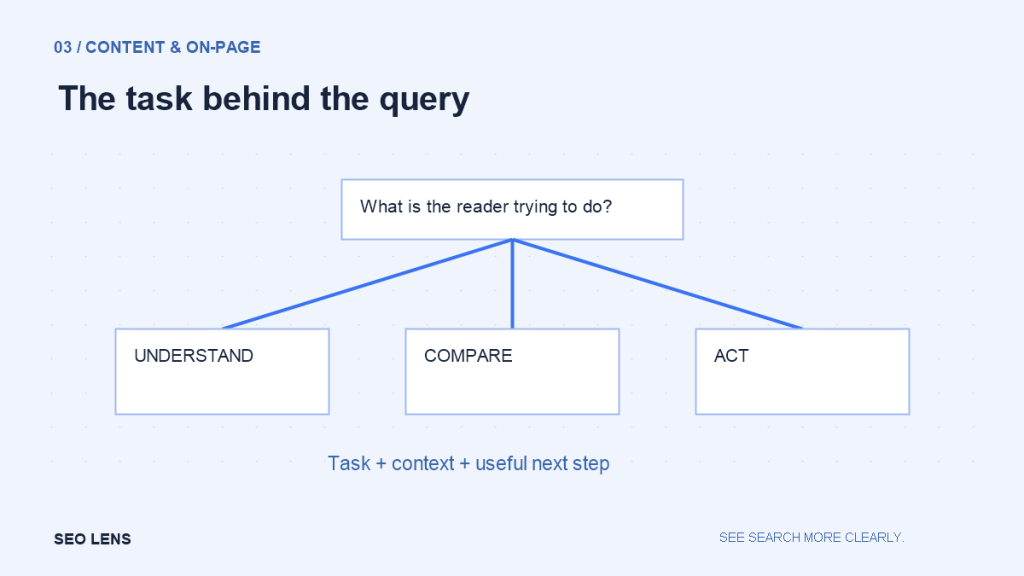
Intent analysis becomes more useful when it describes a task: what the person is trying to accomplish, what they already know and what would let them move forward. The familiar informational, navigational, commercial and transactional labels can be an opening classification. They should not be the final editorial decision.
Describe the task in a complete sentence Replace “informational keyword” with something more concrete: “A site owner wants to understand why a published page has not appeared in search and identify the next check.” That sentence implies a diagnostic sequence, examples and distinctions between possible causes.
Compare it with “An experienced developer needs the syntax for a robots directive.” The second reader may need a concise reference more than a long introduction. Word count cannot resolve the difference. A useful brief should explain the reader’s starting state and the desired outcome before discussing headings.
Write down constraints as well. Does the reader have a particular CMS, budget, location, device or level of access? Some constraints appear in the query; others need careful inference. Label inferred assumptions so the writer does not present them as established facts.
Read the results as evidence Review a sample of relevant search results in the market and language you serve. Note the kinds of pages, not just the words in their titles. Are they tools, category pages, step-by-step guides, official documentation, discussions or short definitions? Do several formats coexist?
A mixed results page may indicate several plausible tasks. It does not always mean you should build one enormous page covering all of them. You might choose one underserved task and explain that scope clearly, or create distinct resources when each has a defensible purpose.
Results are evidence of what a search system currently serves, not a complete specification of what all users want. Treat the observed pattern as a hypothesis. Customer questions, site search, support requests and usability feedback can confirm or challenge it. Avoid copying competitors’ outlines as if their structure were the ranking mechanism.
Separate topic, format and depth The topic is what the page concerns. The format is how it helps. Depth is how much explanation the task requires. A page about canonical tags might be a conceptual guide, a syntax reference, a migration checklist or a debugging flowchart.
For a diagnostic task, lead with the decision the reader needs to make. Explain alternatives and show the evidence that distinguishes them. For a reference task, make the answer easy to locate. For a comparison, define the criteria before announcing a preference.
Depth should follow uncertainty. If readers routinely confuse two terms, spend words separating them. If a step is obvious and uncontroversial, a short instruction may be enough. This produces more useful variation than applying the same long-form template to every search phrase.
Account for the next action A person researching a software category may not be ready to buy, but may be ready to create a shortlist. A useful page could explain evaluation criteria, limitations and questions to ask. A sales button repeated after every paragraph may distract from that actual next step.
For an editorial publication, the next action is often another explanation, a practical check or a source document. Internal links should serve that action. Linking every article to a single commercial destination regardless of context weakens the reading experience and can make the publication’s purpose unclear.
Map the route to related material before drafting. Our site architecture framework is useful here: pages should connect around tasks, not merely share a keyword. A reader learning about indexability may need a crawl explanation before an advanced audit checklist.
Use a compact intent brief 1. Reader: who is likely to arrive, and with what knowledge? 2. Task: what are they trying to decide, understand or do? 3. Evidence: what do results and first-party questions suggest? 4. Format: what presentation best supports the task? 5. Scope: what will this page answer, and what belongs elsewhere? 6. Completion: what should the reader be able to do afterward?
Add a confidence level when the evidence is thin. A brief based on three queries and no customer research should not sound more certain than it is. That does not prevent publication; it tells the team what to learn next.
Diagnose underperformance without guessing A page receiving impressions but few clicks might have a weak title, appear in an unattractive position, match broad queries poorly or compete with a crowded results layout. Low click-through rate alone does not identify an intent problem.
Look at query groups and landing-page behavior. Does the page attract searches outside its intended scope? Are visitors finding the central answer? Are useful next actions visible? Analytics can suggest questions, but a short visit does not automatically mean failure; a concise answer can satisfy someone quickly.
If you revise the page, record the hypothesis and date. Compare a suitable period and avoid changing the title, content, template and linking strategy simultaneously when you want to understand the result. Search performance changes for many reasons, so be cautious about declaring causation from a before-and-after chart.
Keep intent analysis open to revision Search behavior and result formats change. Revisit high-value pages when their query mix shifts, users ask new questions or the product category changes. A periodic review is more useful than constantly rewriting pages in response to isolated ranking movements.
The output of intent research should be a clearer editorial choice. Sometimes that means a more complete guide; sometimes a shorter answer, a better comparison or a separate resource. Read SEO metrics in context before using a single traffic number to judge the choice.