
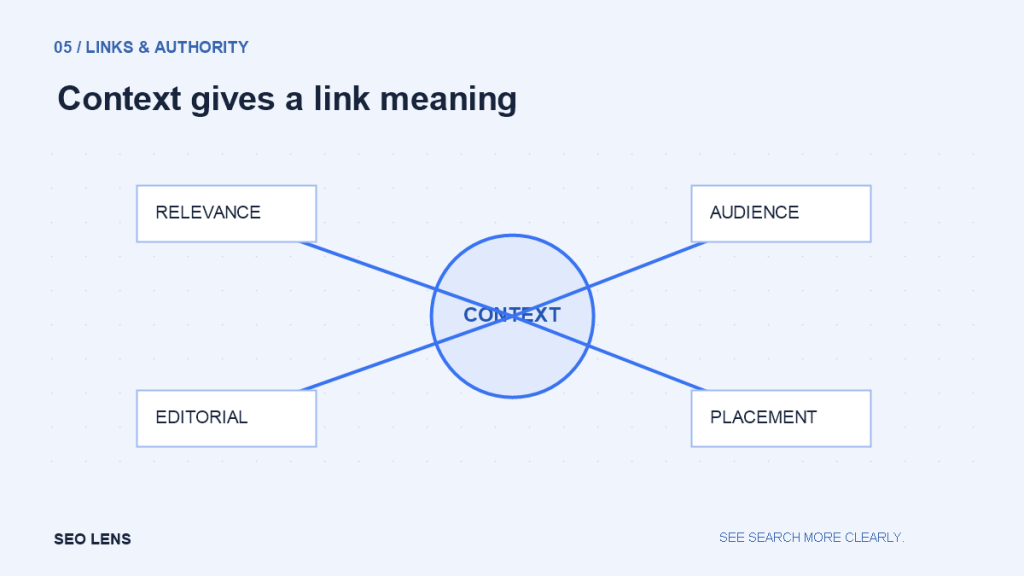
A link can be valuable for several reasons: it sends relevant readers, supports a useful citation, helps a new audience discover your work or contributes to how search systems interpret the web. Those benefits overlap, but they are not interchangeable. A link that produces no measurable referral visits is not automatically worthless, and a high-scoring domain is not automatically a good place to seek a mention.
Begin by asking what you expect from the link. If the goal is qualified readership, evaluate the audience and the referring page. If the goal is evidence of editorial recognition, examine why the citation exists. A single authority number cannot answer either question.
Evaluate the page before the domain Domain-level scores compress a large and changing web into a convenient comparison. They can help organize research, but they do not describe the exact page, its visibility or the reason a link appears there. A strong publication may contain an abandoned page that few people encounter.
Open the referring page. Does it offer a coherent answer? Is the link visible in the main discussion, a resource list, a profile or a repeated template? Would a reader understand why your page is being cited? Check whether the destination delivers what the surrounding text promises.
Page quality is not equivalent to expensive design. A plain specialist resource can be useful, while a polished site can publish shallow material. Look for subject competence, original contribution and a recognizable purpose. Avoid treating one aesthetic signal as a verdict.
Relevance is contextual Topical relevance can exist at several levels. A general newspaper might publish a highly relevant report. A niche website might place your link on a page about an unrelated subject. The local context often explains more than the site’s broad category.
Consider audience relevance as well. A mention in a small technical community may reach people who can use and discuss your work. That is a different benefit from broad exposure, but it can be valuable. Define the audience before deciding that a modest publication is unimportant.
Be cautious with formulaic rules such as requiring the same keyword in the domain, title and anchor. They can encourage artificial targeting and miss legitimate citations. A useful link relationship should make sense when read aloud in its surrounding paragraph.
Editorial purpose is a strong practical test Ask whether the page would still include the link if search engines ignored it. A citation supporting a claim, a credit for original research or a useful reference often passes that test. A paid insertion into an unrelated sentence may not.
This is a decision aid, not a claim that you can reverse-engineer a search engine’s treatment of the link. You rarely know every signal or every commercial relationship behind a page. Record what you can observe and separate it from what you assume.
If your organization sponsors a placement, handle the relationship transparently and use appropriate link qualification. Google’s spam policies address links created primarily to manipulate rankings. Do not turn a legitimate publicity program into a list of undisclosed paid ranking placements.
Placement and durability change the opportunity A citation in a lasting reference can remain useful for years, while a link in a rapidly moving feed may receive attention for a day. Neither is inherently superior; the expected benefit differs. A news announcement can be valuable precisely because it reaches readers at the right moment.
Inspect whether the page is publicly accessible, whether the link is a normal usable destination and whether the site has a plausible maintenance pattern. A buried page that disappears shortly after publication presents a different risk from a stable resource with a clear owner.
Avoid promises that a placement will remain forever unless the publisher actually provides that commitment. Even then, websites migrate, close and change editorial policy. Measure the outcome you can observe instead of valuing permanence as a certainty.
Traffic estimates require humility Third-party traffic estimates are models. They can be useful for comparing broad patterns, but they are not the publisher’s analytics and may miss non-search audiences. Low estimated organic traffic does not prove that a page has no readers.
Where you control the destination, look for referral visits and useful downstream actions. A small number of well-matched readers may matter more than a large burst of irrelevant sessions. Keep attribution limits in view: privacy settings, apps and copied links can obscure the original source.
Do not use a missing referral row as conclusive evidence that nobody saw the mention. Use it as one piece of a wider evaluation. Our metrics guide explains why a proxy should not quietly become the objective.
A practical review sheet 1. Record the exact referring page and destination. 2. Describe the editorial reason for the citation. 3. Assess the page’s topic, audience and usefulness. 4. Note placement, link attributes and any commercial relationship. 5. Review likely visibility and the uncertainty in available estimates. 6. Decide whether the opportunity is worthwhile without a guaranteed ranking effect.
Use short written judgments rather than an opaque total score. “Relevant specialist audience; useful citation; uncertain reach” is more informative than an unexplained 82 out of 100. Teams can debate the evidence and update the judgment when new information arrives.
Build something worth referencing The most controllable part of earning editorial attention is the destination itself. Original measurements, clear diagrams, maintained references and careful explanations give other writers a reason to cite your work. Publishing another generic summary does not create the same reason.
Distribution still matters. Make relevant communities aware of work that answers their questions, and explain its limitations. Avoid mass messages promising reciprocal links or guaranteed ranking benefits. The objective is a useful relationship between a source, a reader and your page.
Once readers arrive, give them a clear next step through internal links. External attention is less useful when the destination is disconnected from the rest of the publication.